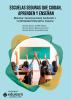
Escuelas Seguras que Cuidan, Aprenden y Enseñan: Bienestar Socioemocional, Inclusión y Continuidad Educativa Segura.
Palabras clave:
Educación inclusiva, seguridad escolar, clima escolar, evaluación formativa, e-learningSinopsis
En escuelas seguras que cuidan, aprenden y enseñan, la prioridad son las y los docentes de educación básica y bachillerato que deben sostener el aprendizaje en contextos de riesgo, con enfoque de bienestar socioemocional, inclusión y seguridad escolar. El libro traduce marcos vigentes y evidencia aplicada en Ecuador en decisiones de aula: integra competencias SEL, clima de aula y DUA, delimita el rol pedagógico frente a señales de riesgo y establece rutas claras de derivación al DECE, con lenguaje no revictimizante y resguardo de datos, la escuela se concibe como un espacio que protege, enseña y aprende, con prácticas contextualizadas y éticas al alcance del profesorado.
El recorrido se organiza en cuatro capítulos que se complementan, el Capítulo 1 ofrece fundamentos de SEL, clima y DUA con límites profesionales y salvaguardas éticas para el aula, el Capítulo 2 baja a la práctica con secuencias diferenciadas para primaria y secundaria, juegos cooperativos, voz del estudiante y microprotocolos, el Capítulo 3 asegura la continuidad pedagógica en escenarios presenciales, virtuales e híbridos con bienestar y ciudadanía digital, accesibilidad y privacidad por diseño, el Capítulo 4 instala una evaluación formativa que recoge evidencias útiles, retroalimenta con criterios visibles y cierra bucles de mejora continua, todo con ejemplos, instrumentos mínimos y coordinación con DECE.
La propuesta incluye rúbrica SEL, matriz de adaptaciones NEE, checklist de riesgo y convivencia, PIA y plantilla de retroalimentación, para convertir el cuidado y la inclusión en ciclos visibles de planificar, actuar, observar, ajustar sin estigmatizar. Se acompaña de tableros mínimos con indicadores de participación, autorregulación y continuidad, comunicaciones claras con familias y protocolos breves para incidentes presenciales y en línea, el énfasis está en lo que cada docente puede hacer “con lo que tiene y desde donde está”, articulando evidencias, ética y coordinación institucional para sostener trayectorias educativas seguras y equitativas.
Referencias
Almeqdad, Q. I., Alquraan, M. F., Mohaidat, M. A., & Al-Makhzoomy, A. K. (2023). The effectiveness of universal design for learning: A systematic review and meta-analysis. Cogent Education, 10(1), 2218191. https://doi.org/10.1080/2331186X.2023.2218191
Cipriano, C., Strambler, M. J., Naples, L. H., Ha, C., Kirk, M., Wood, M., … Durlak, J. (2023). The state of evidence for social and emotional learning: A contemporary meta-analysis of universal school-based SEL interventions. Child Development. https://pubmed.ncbi.nlm.nih.gov/37448158/
Demirtaş-Zorbaz, S., & Akın-Arıkan, Ç. (2021). Does school climate that includes students’ views deliver academic achievement? A multilevel meta-analysis. School Effectiveness and School Improvement. https://doi.org/10.1080/09243453.2021.1920432
Department for Education. (2024). Keeping children safe in education. https://www.gov.uk/government/publications/keeping-children-safe-in-education--2
International Telecommunication Union & UNICEF. (2021). Child Online Protection Guidelines. https://www.itu-cop-guidelines.com/
Maynard, B. R., Farina, A., Dell, N. A., & Kelly, M. S. (2019). Effects of trauma-informed approaches in schools: A systematic review. Campbell Systematic Reviews, 15(1), e1018. https://doi.org/10.1002/cl2.1018
OECD. (2021). Education Policy Outlook 2021: Shaping responsive and resilient education in a changing world. OECD Publishing. https://doi.org/10.1787/75e40a16-en
UNESCO. (2022–2030). Comprehensive School Safety Framework 2022–2030. https://gadrrres.net/files/cssf_2022-2030_en.pdf
Wisniewski, B., Zierer, K., & Hattie, J. (2020). The power of feedback revisited: A meta-analysis of educational feedback research. Frontiers in Psychology, 10, 3087. https://doi.org/10.3389/fpsyg.2019.03087
Xuan, X., Wang, H., Liu, J., Guan, C., Jiang, Y., & Pang, B. (2022). Effects of formative assessment on academic achievement: A meta-analysis. Frontiers in Psychology, 13, 990196. https://doi.org/10.3389/fpsyg.2022.990196
Almeqdad, Q. I., Alquraan, M. F., Mohaidat, M. A., & Al-Makhzoomy, A. K. (2023). The effectiveness of universal design for learning: A systematic review of the literature and meta-analysis. Cogent Education, 10(2), 2218191. https://doi.org/10.1080/2331186X.2023.2218191
Ayalew, Y. E., Verdoodt, V., & Lievens, E. (2024). General Comment No. 25 on children’s rights in relation to the digital environment: Implications for children’s right to privacy and data protection in Africa. Human Rights Law Review. https://doi.org/10.1093/hrlr/ngae018
Cipriano, C., Barnes, T. N., Rivers, S. E., Brackett, M. A., & Jones, S. M. (2023). The state of evidence for social and emotional learning. Child Development. https://doi.org/10.1111/cdev.13968
Double, K. S., McGrane, J. A., & Hopfenbeck, T. N. (2020). The impact of peer assessment on academic performance: A meta-analysis of controlled studies. Educational Psychology Review, 32(2), 481–509. https://doi.org/10.1007/s10648-019-09510-3
International Telecommunication Union (ITU), & UNICEF. (2021). Child online protection guidelines. https://www.itu.int/cop
Johnson, C. C., Veletsianos, G., & Seaman, J. (2023). Online teaching in K–12 education in the United States: A review of the literature. Review of Educational Research, 93(5), 697–740. https://doi.org/10.3102/00346543221105550
Liu, Q., & Khalil, M. (2023). Understanding privacy and data protection issues in learning analytics using a systematic review. British Journal of Educational Technology, 54(6), 1715–1747. https://doi.org/10.1111/bjet.13388
OECD. (2021). Education Policy Outlook 2021: Shaping responsive and resilient education in a changing world. OECD Publishing. https://doi.org/10.1787/75e40a16-en
OECD. (2023). OECD Digital Education Outlook 2023: Towards an effective digital education ecosystem. OECD Publishing. https://doi.org/10.1787/c74f03de-en
Sortwell, A., Trimble, K., Ferraz, R., Geelan, D. R., Hine, G., Ramirez-Campillo, R., Carter-Thuiller, B., Gkintoni, E., & Xuan, Q. (2024). A systematic review of meta-analyses on the impact of formative assessment on K-12 students’ learning: Toward sustainable quality education. Sustainability, 16(17), 7826. https://doi.org/10.3390/su16177826
UNICEF (Regional Office for Europe and Central Asia). (2024). Data protection in schools: Guidance for legislators, policy makers and schools. https://www.unicef.org/eca/reports/data-protection-schools
UNICEF Office of Research – Innocenti. (2024). Making digital learning work: The Akelius initiative. https://www.unicef.org/innocenti/media/9806/file/UNICEF-Innocenti-Making-Digital-Learning-Work-Akelius-Initiative-2024.pdf
Wisniewski, B., Zierer, K., & Hattie, J. (2020). The power of feedback revisited: A meta-analysis of educational feedback research (2010–2018). Frontiers in Psychology, 10, 3087. https://doi.org/10.3389/fpsyg.2019.03087
Xuan, Q., Yeung, S.-S., Jung, J., Wong, M.-W., & Tong, X. (2022). The effectiveness of formative assessment for enhancing reading achievement in K-12: A meta-analysis. Frontiers in Psychology, 13, 990196. https://doi.org/10.3389/fpsyg.2022.990196
Zhang, P., & Kamel Boulos, M. N. (2022). Privacy-by-design environments for large-scale health research and federated learning from data. International Journal of Environmental Research and Public Health, 19(19), 11876. https://doi.org/10.3390/ijerph191911876
Descargas
Publicado
octubre 31, 2025
Derechos de autor 2025 EduLearn Academy SAS
Detalles sobre esta monografía
ISBN-13 (15)
978-9942-7393-5-3
Cómo citar
Ramírez Gaona, J. M., Ramírez Gaona, M. C., & Ramírez Gaona, J. V. (Eds.). (2025). Escuelas Seguras que Cuidan, Aprenden y Enseñan: Bienestar Socioemocional, Inclusión y Continuidad Educativa Segura. EduLearn Academy SAS. https://doi.org/10.64973/edu.2025.2517